Saturday, 2 May 2020

Day 23 - Creative Thinking


Picture credit - The Hindu
Day 23 - Creative Thinking Skill
2 May 2020
sirurp@gmail.com

What is Creative Thinking Skill?

Creative thinking is the ability to look at things differently, and find new ways of solving problems

My learning for the day

Author - James Clear, known for his amazing book Atomic Habits
Nearly all great ideas follow a similar creative process and this article explains how this process works.
James Clear writes about James Webb Young’s 5 step technique for producing Ideas and shares a story of someone who put the technique into practice.

James Webb Young’s 5 step technique

1. Gather new material (research) - At first, you learn. During this stage you focus on a) learning specific things directly related to your task and b) learning general things about a wide range of concepts
2. Thoroughly work over the materials in your mind (immerse) - During this stage, you examine what you have learned by looking at the facts from different angles and experimenting with fitting various ideas together.
3. Step away from the problem (get away) - Next, you put the problem completely out of your mind and go do something else that excites you and energizes you.
4. Let your idea return to you (insight) - At some point, but only after you have stopped thinking about it, your idea will come back to you with a flash of insight and renewed energy.
5. Shape and develop your idea based on feedback (from blur to concrete) - For any idea to succeed, you must release it out into the world, submit it to criticism, and adapt it as needed
Thanks Nataliya. Picked some nice words from your article.

Young’s idea in practice

This is Frederic Eugene Ives’ story. The creative process used by Frederic Eugene Ives is a perfect example of these five steps in action.
Ives was from an era of the printing world where, in the 1870s, photography was a new and exciting medium. Readers wanted to see more pictures, but nobody could figure out how to print images quickly and cheaply.
The Ives Process, as it came to be known, reduced the cost of printing images by 15x. This process remained as the standard printing technique for the next 80 years
1. First, Ives learnt and gathered new material - He spent two years working as a printer's apprentice and then four years running the photographic laboratory at Cornell University. These experiences gave him a lot of material to draw upon and make associations between photography and printing
2. Then Ives began to mentally work over everything he learned spending nearly all of his time experimenting with new techniques, putting ideas together
3. Third, Ives stepped away from the problem. In this case, he went to sleep for a few hours before his flash of insight. Letting creative challenges sit for longer periods of time can work as well. Regardless of how long you step away, you need to do something that interests you and takes your mind off of the problem
4. Fourth, his idea returned to him as a flash of insight when he was sleeping.  Ives awoke with the solution to his problem laid out before him
5. Finally, Ives continued to revise his idea for years. In fact, he improved so many aspects of the process he filed a second patent.
Being creative isn't about being the first (or only) person to think of an idea. More often, creativity is about connecting ideas.

I dedicate this piece to Mansukhbhai Jagani, the innovative farmer who converts motorbikes into low cost tractors and sprayers.

Stories about creativity

While there are umpteen number of stories about creativity right from the Eureka moment of Archimedes, to Newton and the apple falling on his head, to James Watson’s dream seeing two intertwined serpents that led him to discover three-dimensional double helix in DNA molecule, here are the two that are from two diverse businesses. 

Mansukhbhai Jagani’s story

Jagani appears in Forbes' list of seven most powerful rural Indian entrepreneurs
Jagani developed a motorcycle-based tractor (He calls it Bullet Santi) for India's poor farmers, which is both cost effective - costing roughly USD 318, and fuel efficient (it can plow an acre of land in 30 minutes with two liters of fuel). I have had the fortune of meeting him and seeing him in action in 2013 when I visited his village

Peter Ueberroth’s story

Early in the modern history of the Olympic Games, countries used public funds to organise the games. This model of funding proved unsustainable and ended in 1976 with the Montreal Summer Games that incurred huge losses (~$700Mn).
In 1984, Los Angeles did something unusual - it hosted the Summer Olympics and turned a profit (more than $200 million). 
Peter Ueberroth, chairman of the Los Angeles Olympic Organizing Committee, made a success out of a seemingly loss making proposition by attracting corporate sponsorship and Television rights.

Hope you can try out James Webb Young’s 5 step technique and get great insights.

How to improve this skill?

Set a goal to become a go-to person by mastering the art and science of creative thinking
Follow the LAST model to build your personal brand as a Guru of creative thinking
  1. Learn - Invest time in learning different frameworks/ models/ techniques of creative thinking 
  2. Apply - 
    • Identify a model suitable to you
    • Create a template to document the flow of the process
    • Find opportunities to use the selected method/ template
    • Maintain record/ process flow of every important activities you did to with respect to creative thinking
    • Maintain notes of your thoughts/ insights/ failures/ challenges…. to be used for sharing/ training others
  3. Share - Share the insights captured in step 2 above in a planned manner (social media posts, blogs, videos, study notes…)
  4. Train - Generate opportunities to train your peers and team members so that, over time, your organization benefits from your efforts

Purpose of this document

I took a 66 day challenge to study Life Skills last year (10 April 2019). To my astonishment, I succeeded in studying for 66 days one skill a day. 
My objectives of learning these skills were - To strengthen my mind to face life’s challenges with ease, To use these skills in my worklife for a better performance, To use these skills in my personal life for enriching my relationships, To open new possibilities to surprise myself. 
This is my next 66 day challenge (from 10 April 2020) - To share my Life Skills learning with my social media friends. 
I pray that my toil helps you in your success journey.

What are Life Skills?

UNICEF defines Life skills as - psychosocial abilities for adaptive and positive behaviour that enable individuals to deal effectively with the demands and challenges of everyday life. They are loosely grouped into three  broad categories of skills
  • cognitive skills for analyzing and using information, 
  • personal skills for developing personal agency and managing oneself, 
  • inter-personal skills for communicating and interacting effectively with others.

Which LifeSkills are covered?

The World Health Organisation identified these basic areas of life skills that are relevant across cultures: 
  1. Decision-making
  2. Problem-solving
  3. Creative thinking
  4. Critical thinking
  5. Communication
  6. Interpersonal skills
  7. Self-awareness
  8. Empathy
  9. Coping with emotions
  10. Coping with stress.

Some trivia

‘Life skills’ was never part of the school curriculum. WHO/ UNESCO mandated academia to teach these skills in all schools across the globe in 1993.
Different countries educate their children in these skills with different objectives

  • Zimbabwe and Thailand - prevention of HIV/AIDS
  • Mexico - prevention of adolescent pregnancy
  • United Kingdom - child abuse prevention
  • USA - prevention of substance abuse and violence
  • South Africa and Colombia - positive socialization of children.


Friday, 1 May 2020

Day 22 - Problem Solving Skill


Picture credit - Business-online-learning

Day 22 - Problem-Solving Skill
1 May 2020
sirurp@gmail.com


What is Problem-Solving Skill?

Problem-Solving Skill is the ability to determine the source of a problem and find an effective solution.

My learning for the day

Sharing my learning about the Fishbone Diagram (also called Ishikawa diagram), a problem solving tool.
This tool was created by Kaoru Ishikawa (1915-1989) in 1968. Kaoru Ishikawa was a Japanese Professor at the Faculty of Engineering at The University of Tokyo, noted for his quality management innovations.

What is the fishbone diagram?

The Fishbone diagram is a visual tool used for root cause analysis. 
Once we understand, using this tool, the root causes of the problem, we can put our efforts to find ways to rectify the causes.
The Fishbone diagram consists of Head of the Fish (to write the problem) and its skeletal bones (to write down the cause of the problem).
This is a typical workflow of how Fishbone diagram is created
Step 1: Write the problem in the head of the fish
Step 2: List all causes and group them into categories (or choose one from existing known categories e.g. T.P. Write’s 5M model for manufacturing industry, E. Jerome McCarthy’s marketing mix model for marketing sector or 4S model for service industry)
Step 3: Feed all the categories (and causes under each) in the skeletal bones of the fish to get a visual view of the problem and all possible causes 
Step 4: Identify action plans to rectify key causes

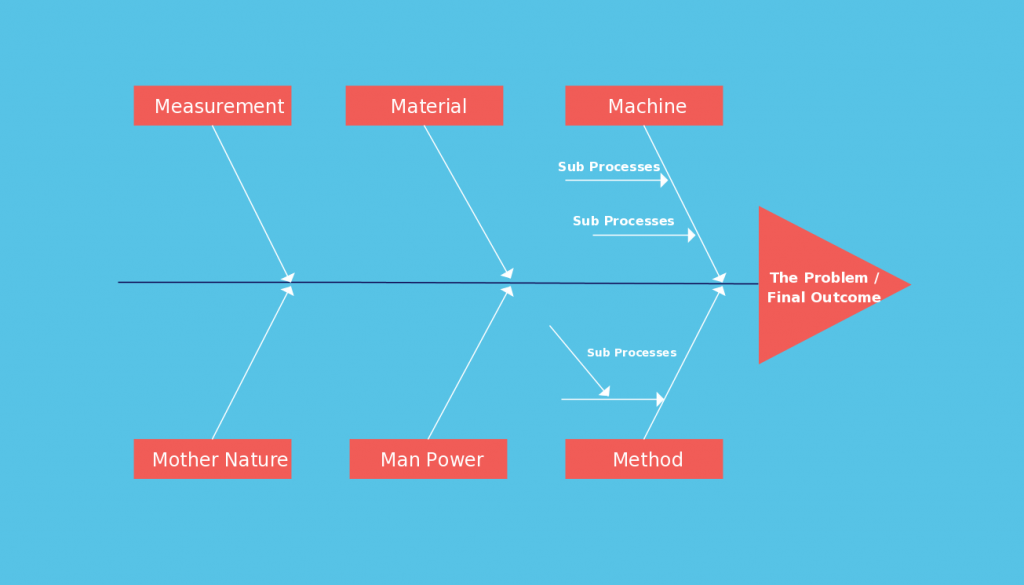
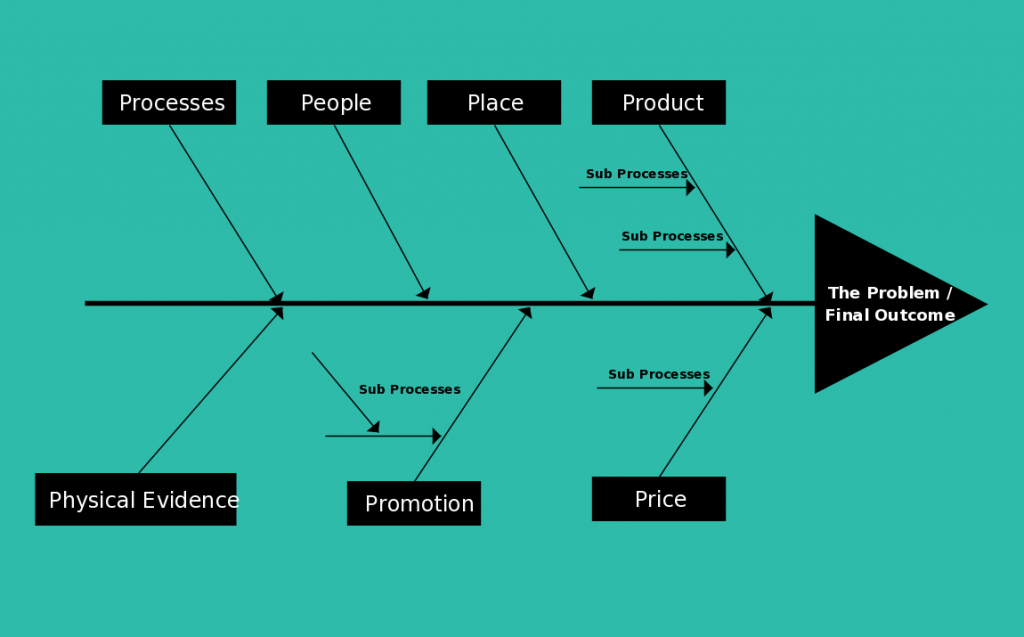
Typical fishbone diagrams 

Based on T.P. Write’s 5M model (for manufacturing sector)

Based on E. Jerome McCarthy’s marketing mix model (for marketing sector)

An example - Service failure in a hotel

Mr. Reo Enud (imaginary word scrambled from ‘Rude One’) booked a customer accidentally in a ‘smoking room’. On top of that the person in reception gave the wrong key card to the customer. All the rooms were full.
Problem - Service failure
Category (buckets of causes) chosen - 4S (Surroundings, Suppliers, Systems, Skills)
Causes under each category - 
Surroundings - Upgrade not possible because rooms were full, No arrangement with other hotels to shift the customer
Suppliers - Nothing under this category, at least in the first round of brainstorming 
Systems - The computer system did not capture information about customer preferences (e.g. smoking, non-smoking, veg/ vegan/non-veg.....), there were no processes (e.g. how to manage if all rooms are full, how to compensate for workplace mistakes…)
Skills - Lack of customer centricity, No culture of saying sorry
I have provided only a few causes. A good brainstorming within the team can bring out many more causes.
Once we put the above in the fishbone diagram, we clearly see which area to focus on.
Hope this gives you the basics of the Ishikawa diagram.

How to improve your problem solving skills?

Set a goal to become a go-to person by mastering the art and science of problem-solving
Follow the LAST model to build your personal brand as a Guru of problem-solving
  1. Learn - Invest time in learning different frameworks/ models/ techniques of problem-solving 
  2. Apply
    • Identify a model suitable to you
    • Create a template to document the flow of the process
    • Find opportunities to use the selected method/ template
    • Maintain record/ process flow of every important activities you did to with respect to problem-solving
    • Maintain notes of your thoughts/ insights/ failures/ challenges…. to be used for sharing/ training others
  3. Share - Share the insights captured in step 2 above in a planned manner (social media posts, blogs, videos, study notes…)
  4. Train - Generate opportunities to train your peers and team members so that, over time, your organization benefits from your efforts

Purpose of this document

I took a 66 day challenge to study Life Skills last year (10 April 2019). To my astonishment, I succeeded in studying for 66 days one skill a day. 
My objectives of learning these skills were - To strengthen my mind to face life’s challenges with ease, To use these skills in my worklife for a better performance, To use these skills in my personal life for enriching my relationships, To open new possibilities to surprise myself. 
This is my next 66 day challenge (from 10 April 2020) - To share my Life Skills learning with my social media friends. 
I pray that my toil helps you in your success journey.

What are Life Skills?

UNICEF defines Life skills as - psychosocial abilities for adaptive and positive behaviour that enable individuals to deal effectively with the demands and challenges of everyday life. They are loosely grouped into three  broad categories of skills
  • cognitive skills for analyzing and using information, 
  • personal skills for developing personal agency and managing oneself, 
  • inter-personal skills for communicating and interacting effectively with others.

Which LifeSkills are covered?

The World Health Organisation identified these basic areas of life skills that are relevant across cultures: 
  1. Decision-making
  2. Problem-solving
  3. Creative thinking
  4. Critical thinking
  5. Communication
  6. Interpersonal skills
  7. Self-awareness
  8. Empathy
  9. Coping with emotions
  10. Coping with stress.

Some trivia

‘Life skills’ was never part of the school curriculum. WHO/ UNESCO mandated academia to teach these skills in all schools across the globe in 1993.
Different countries educate their children in these skills with different objectives
  • Zimbabwe and Thailand - prevention of HIV/AIDS
  • Mexico - prevention of adolescent pregnancy
  • United Kingdom - child abuse prevention
  • USA - prevention of substance abuse and violence
  • South Africa and Colombia - positive socialization of children.


Day 21 - Decision making skill


Picture credit - publicdomainpictures
Day 21 - Decision-Making Skill
30 April 2020
What is Decision-Making Skill?
Decision-Making Skill is the ability to use a decision making process/ technique to arrive at a decision.

My learning for the day

A major part of decision-making involves the generating alternatives and then ranking of these alternatives in terms of impacts. Only after that can we take a decision objectively.
Edward De Bono, father of Lateral Thinking, came up with a set of thinking tools called DATT (Direct Attention Thinking Tools).
This is what I learnt a long time ago from Peter De Bono (dedicating this post to Peter).
When looking for alternatives, most of us fail in the following areas - 
  • We fail to look for something
  • We see only part of the solution
  • We leave things out
  • We fail to take into account the consequences of our decisions or to ask people about their views

A.P.C. (Alternatives, Possibilities, Choices)

One of the thinking tools I learnt is called A.P.C.
This tool is used when we try to understand something or to make a prediction or to identify actions
It has two steps -
  • List down available traditional alternatives
  • Use creativity to generate further alternatives

CAF (Consider All Factors)

The other tool I learnt is called CAF (Consider All Factors)
The factors-list will help us when we validate the alternatives. Some sample factors and validation questions are as below - 
  • Purpose factor - Does the alternative meet the purpose?
  • Feasibility factor - Is it affordable? Can we actually implement the alternative?
  • Fit factor - e.g. Is the alternative environment friendly?
  • Acceptance factor - What factors will aid acceptance by all stakeholders?
  • Impact factor - What are the benefits and what are the dangers?
 A few interesting examples of impacts of decisions that did not validate key factors
- Don Sahong hydropower project, Cambodia - When taking the decision to take up the project, the government may have missed a factor (fit factor) that the project could impact lives of Mekong dolphins and take them to extinction
- Four Pests Campaign - This project was introduced by China in 1958 as part of the Great Leap Forward initiative to multiply grain yield. One of the programmes was to eliminate sparrows that were eating large quantities of grains. When taking the decision, the government may not have taken into account the impact of this decision, that sparrows eat a large number of insects also. With no sparrows to eat them, locust populations ballooned, swarming the country and causing immense damage to farms
- The Hindenburg mishap - Zeppelin company’s disastrous decision to fill its airships with highly flammable hydrogen, instead of less combustible alternatives, led to a disaster. On May 6th, 1937 the Hindenburg airship tried to dock after its trans-Atlantic flight, when it suddenly erupted in flames and was destroyed completely in37 seconds. This shattered public confidence in that mode of transport, and brought the airship era to an end. 
- Berlin Conference 1884 - The purpose of this conference was to finalize the claims on African territories by the colonial powers. This was to end the constant battles among them to own the African natural resources. When agreeing the ownership map, they forgot the heritage and ethnicity factor of the people living there. This decision resulted in continuous civil wars happening in the continent for the past so many decades 

How to improve your decision making skills?

Set a goal to become a go-to person by mastering the art and science of decision-making
Follow the LAST model to build your personal brand as a Guru of decision-making
  1. Learn - Invest time in learning different frameworks/ models/ techniques of decision-making 
  2. Apply
    • Identify a model suitable to you
    • Create a template to document the flow of the process
    • Find opportunities to use the selected method/ template
    • Maintain record/ process flow of every important activities you did to with respect to decision-making
    • Maintain notes of your thoughts/ insights/ failures/ challenges…. to be used for sharing/ training others
  3. Share - Share the insights captured in step 2 above in a planned manner (social media posts, blogs, videos, study notes…)
  4. Train - Generate opportunities to train your peers and team members so that, over time, your organization benefits from your efforts

Purpose of this document

I took a 66 day challenge to study Life Skills last year (10 April 2019). To my astonishment, I succeeded in studying for 66 days one skill a day. 
My objectives of learning these skills were - To strengthen my mind to face life’s challenges with ease, To use these skills in my worklife for a better performance, To use these skills in my personal life for enriching my relationships, To open new possibilities to surprise myself. 
This is my next 66 day challenge (from 10 April 2020) - To share my Life Skills learning with my social media friends. 
I pray that my toil helps you in your success journey.

What are Life Skills?

UNICEF defines Life skills as - psychosocial abilities for adaptive and positive behaviour that enable individuals to deal effectively with the demands and challenges of everyday life. They are loosely grouped into three  broad categories of skills
  • cognitive skills for analyzing and using information, 
  • personal skills for developing personal agency and managing oneself, 
  • inter-personal skills for communicating and interacting effectively with others.

Which LifeSkills are covered?

The World Health Organisation identified these basic areas of life skills that are relevant across cultures: 
  1. Decision-making
  2. Problem-solving
  3. Creative thinking
  4. Critical thinking
  5. Communication
  6. Interpersonal skills
  7. Self-awareness
  8. Empathy
  9. Coping with emotions
  10. Coping with stress.

Some trivia

‘Life skills’ was never part of the school curriculum. WHO/ UNESCO mandated academia to teach these skills in all schools across the globe in 1993.
Different countries educate their children in these skills with different objectives
  • Zimbabwe and Thailand - prevention of HIV/AIDS
  • Mexico - prevention of adolescent pregnancy
  • United Kingdom - child abuse prevention
  • USA - prevention of substance abuse and violence
  • South Africa and Colombia - positive socialization of children.


About Me

My photo
Bangalore, Karnataka, India
My purpose is to manufacture success and happiness